Clear coat repair comes down to one question: is the clear still bonded to the paint underneath? If it is, and the problem is dullness or light oxidation, machine polishing can bring the gloss back. If the clear is flaking, lifting at the edges or looks milky under a smooth surface, no polish, wax or spray will fix it. The panel has to be sanded and refinished, and the new clear needs protecting so it doesn’t fail the same way. In Phoenix, where the sun does most of the damage, that last step matters as much as the repair itself.
This guide shows you how to read the damage, what a lasting repair looks like, what the work costs in the US, and how to keep the new finish alive. We do paint correction, ceramic coating and paint protection film in Phoenix, and we get to those at the point where they help most.
TL;DR
- Clear coat is the thin transparent top layer of your paint. When it loses its grip on the colored layer beneath, it peels, and peeling cannot be polished away.
- Dull or hazy paint with no lifting is usually oxidation, and paint correction can often restore it. Flakes, raised edges or a milky patch mean failure that needs a panel refinish.
- Paint manufacturers specify clear over the whole panel, edge to edge, for lasting repairs. A blended spot repair can look right on delivery and show its edge later.
- Published US guides put single-panel repaint work at roughly $400 to $1,200 and spot repairs at $250 to $800, depending on color, severity and bodywork.
- After any repair, a ceramic coating or paint protection film gives the new clear a defense against Arizona UV and heat.
Table of Contents
- What clear coat does and why it fails
- How to tell oxidation from clear coat failure
- Can you fix peeling clear coat yourself?
- Why the repair has to cover the whole panel
- What clear coat repair costs in the US
- What the Phoenix sun does to clear coat
- Protecting paint after the repair
- When the paint problem is a bigger project
- A short checklist before you book any clear coat repair
- FAQ
- Sources
What clear coat does and why it fails
Modern factory paint is layered: primer, a colored basecoat, then a clear coat on top. The clear carries the gloss and takes the sun, rain, bird droppings and car washes so the color underneath doesn’t have to. It is thin, and it only works while it stays bonded to the basecoat.
There are two different ways it goes wrong, and they need different fixes.
Oxidation is the surface slowly weathering under UV light. The paint turns dull, hazy or chalky, usually first on the roof, hood and trunk lid, the panels that face the sky. The clear is still attached. It is just worn.
Delamination is the clear coat losing adhesion to the basecoat. PPG’s refinish technical guidance lists the causes it sees in refinish work: too much basecoat film build, too little flash-off time (the pause that lets solvents escape) before the clear goes on, and improperly mixed clear. Its correction is to sand the affected areas and refinish. Factory paint can also fail from a weak original bond, and repaint jobs from the wrong prep, which is why a resprayed fender can peel years before the rest of the car.
In practice the two overlap. Years of oxidation weaken the clear until it cracks and lifts. The opposite also happens: a poorly bonded clear can peel on a car that has barely seen sun.
How to tell oxidation from clear coat failure
Walk around the car in daylight, ideally out of direct sun, and look at each panel from a low angle. Then use this as a guide:
| What you see | What it usually means | What it needs |
|---|---|---|
| Even dullness, no lifting, color still visible | Surface oxidation | Paint correction, then protection |
| Hazy or milky patch under a smooth surface | Deterioration inside the clear | Professional assessment, likely refinish |
| Flakes, curling or rough, lifted edges | Clear coat failure | Sand and refinish the panel |
| Bare, dull color or primer showing | Clear gone entirely | Refinish; the basecoat is now exposed |
| Rust bubbles or exposed metal | Failure has reached the panel | Bodywork before any paint |
Two simple checks help. Run a fingernail lightly across the edge of a damaged area: if it catches on a raised, sticker-like edge, the clear is lifting. And look at what happens when a small test area is polished by a professional: if the gloss comes back and stays, the clear is intact. If the surface stays cloudy, or the polish keeps removing material without improvement, the clear is failing structurally.
Do not rub or buff an area that is already flaking. Pressure lifts the loose edges and widens the damage.
One more point trips people up. Because UV hits a roof or hood evenly, a panel that shows one peeling patch is usually weakened across its whole surface. That is why the spot you can see is rarely the whole job, and why the question “how big is the damaged area?” understates the problem.
Can you fix peeling clear coat yourself?
Hardware-store clear coat repair kits and aerosol clear exist, and they can cover a small, isolated patch where the surrounding clear is sound. They cannot restore what the factory or a body shop’s booth process delivers. Spray cans lay down thinner, less uniform film, without the hardeners, controlled temperature and curing that give professional clear its durability. Under Arizona sun, a patch like that tends to cloud or lift again, and the edge of the patch is the first place it shows.
The stronger reason to avoid DIY on peeling clear is that the damaged panel has to be sanded back past the failed edge to a stable surface before anything new goes on. If you leave loose or weakened clear around the patch, the new coat bonds to a bad foundation. Sanding too far, on the other hand, goes through the basecoat and turns a clear coat problem into a color-matching problem.
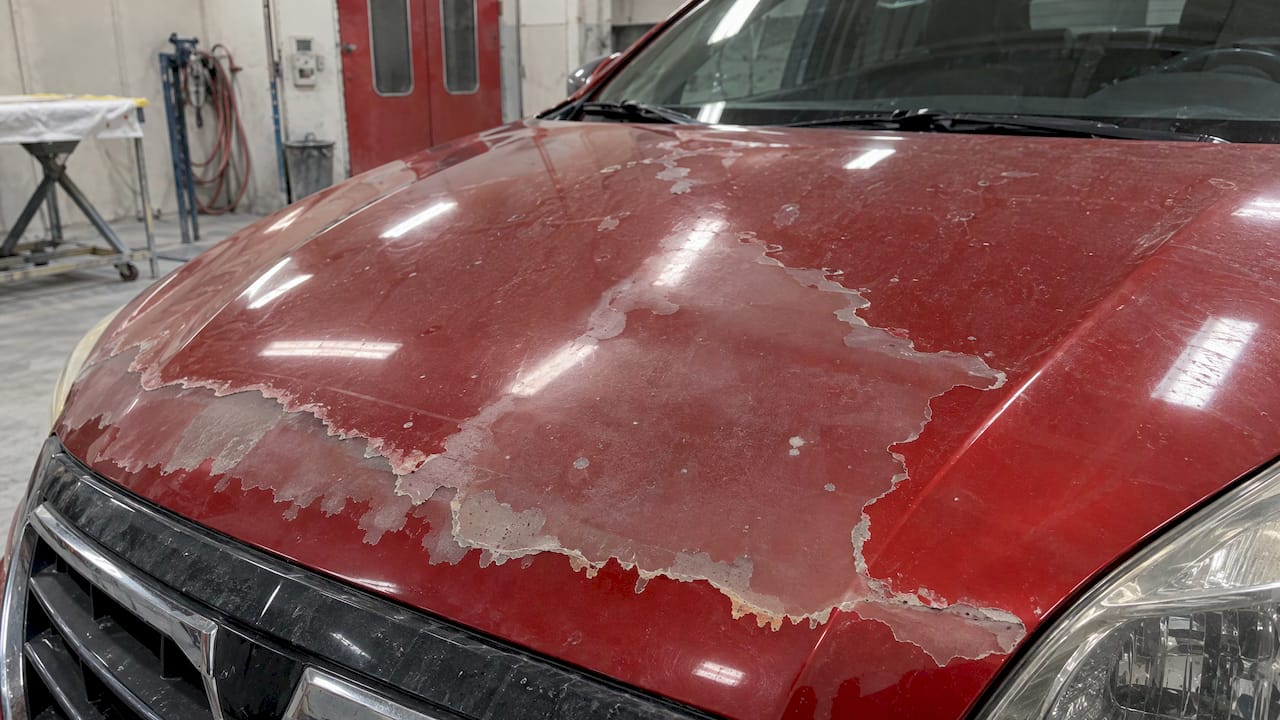
For a daily driver with one small chip, a quick patch may be worth considering. For a car you care about, a classic, a Porsche, a muscle car you are building, the right path is a proper refinish of the panel, done once.
Why the repair has to cover the whole panel
The most common question after “how much” is “can they just blend it?” Blending means feathering new clear into the old clear within a panel so there is no visible line. It is a standard shortcut, and it is the part of a repair most likely to disappoint later.
The paint industry’s guidance is consistent on this:
- Axalta’s guidance to collision repairers states that clear over the full panel is traditional industry practice and is required for its warrantied systems. A blend within the panel may look fine at delivery, but the thin edge of clear has weaker adhesion and weathers poorly, so it can turn cloudy or become visible over the car’s remaining life.
- Mitchell’s refinish documentation notes that major paint manufacturers, including PPG, Axalta, Sherwin-Williams, BASF and Akzo, require clear to extend to the nearest panel edge or breakpoint to qualify for their lifetime warranty on factory basecoat and clear repairs.
- Toyota’s collision repair bulletin, reported in 2021, says clear coat blending does not meet minimum film build requirements and can lead to durability defects in the blended area.
The takeaway for you: the color can be spot-matched and blended into the neighboring paint, but the clear should run edge to edge on the panel. When you compare quotes, ask whether the price covers clearing the whole panel. A low quote often means a blended clear, and that is where the difference comes from.
What clear coat repair costs in the US
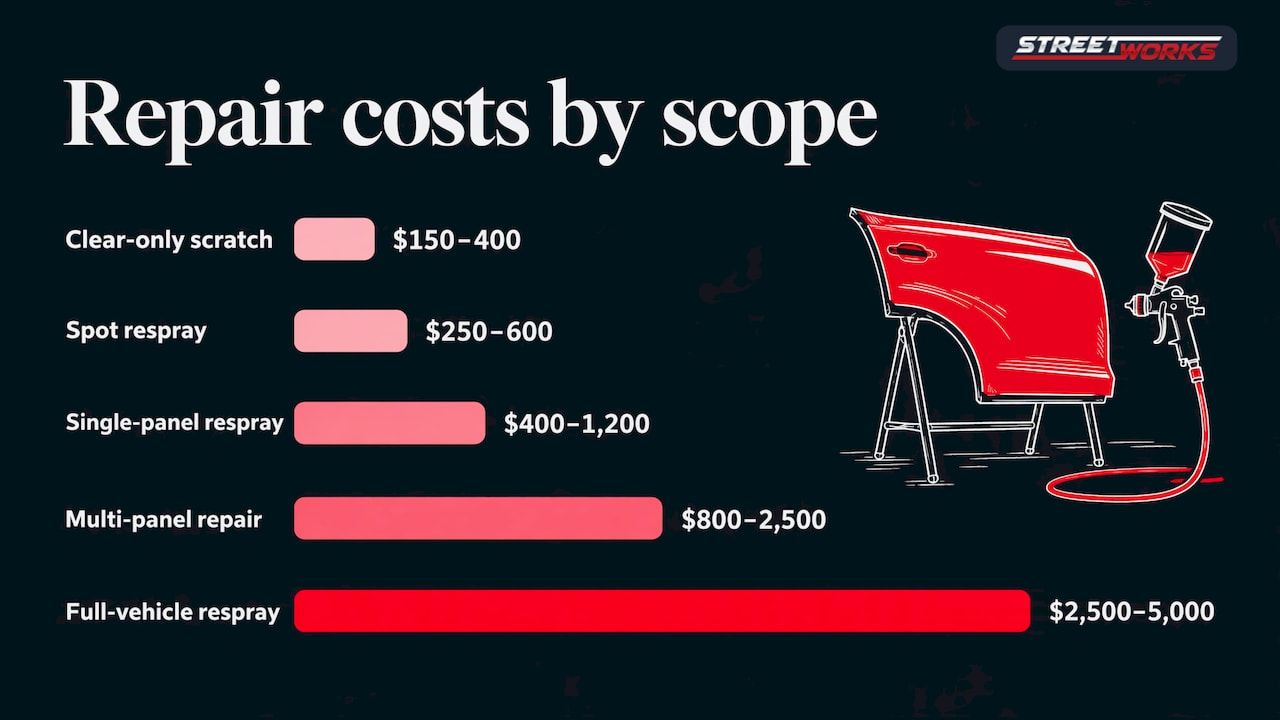
Prices vary by city, shop and car, and the figures below are published guides, not quotes. They are useful for orientation, and your own written estimate is the number that counts.
Ecostify’s February 2026 US guide lists:
- Clear-coat-only scratch repair: $150 to $400 per panel
- Spot or partial respray: $250 to $600
- Full single-panel respray: $400 to $1,200
- Multi-panel repair: $800 to $2,500
- Full-vehicle respray: $2,500 to $5,000 for single-stage paint, $5,000 to $10,000 or more for premium base and clear
AutoBodyRepairs.net’s 2026 pricing guide, which draws on data from 25 US metros, gives a similar picture: $400 to $1,000 for a single-panel repaint and $300 to $800 for a spot repair. It adds that pearl, candy and tri-coat finishes add $200 to $500 compared with solid colors, because matching multi-stage factory colors takes extra colorist time.
What moves the price in your case:
- Severity. A cloudy patch is cheaper than a panel that has to be stripped back to primer.
- Paint type. Solid colors are simpler; pearls, metallics and tri-coats cost more to match.
- Number of panels. Because failure tends to be even across a sun-facing panel, a peeling roof usually means the whole roof, and often the hood and trunk too.
- Underlying bodywork. Rust, dents or old filler found under the failed clear add labor.
- Vehicle value. Correct finish work on a classic or a Porsche is a different job from a quick repaint on a commuter.
If your clear is failing on several panels, the repair is no longer a spot job. At that point it is worth comparing a panel-by-panel fix with a larger paint and body plan, which is the territory of full restoration.
What the Phoenix sun does to clear coat
Clear coat is designed to take UV, but not unlimited UV combined with sustained heat. In the Valley, horizontal panels sit under direct sun for much of the year, and surface temperatures on dark paint climb far above the air temperature. Heat cycles expand and contract the layers, and UV breaks down the clear’s surface. That is the reason roofs, hoods and trunk lids fail first, and why a car that spent years outdoors in Arizona can fail faster than the same car in a mild climate.
This changes how you plan a repair here:
- A weak repair fails sooner. A blended edge or a thin spray-can patch has little margin against desert UV.
- Protection is part of the repair. Fresh clear is at its most vulnerable early in life, and shielding it from UV is cheaper than refinishing it again.
- Parking matters. Shade, a garage or a breathable cover buys years on any finish.
We plan work around Arizona heat and drivability for exactly this reason: the finish has to last in this climate, not just look right on pickup day.
Protecting paint after the repair
Once the clear is sound, whether it was refinished or never failed, the aim is to keep it that way. Three services do this, and they suit different cars.
Paint correction. If your paint is dull from oxidation but not lifting, machine polishing levels the damaged surface layer and restores depth and gloss. It removes a thin amount of clear, so it is a job for a technician who measures what the paint can spare. It is the right first step for hazy, still-bonded clear, and it prepares the surface for protection. Details are on our paint correction page.
Ceramic coating. A ceramic coating adds a hard, chemical-resistant layer over the clear that helps it resist UV, contamination and washing wear. Our published range for a single-stage coating is $700 to $1,200, and we also offer a multi-year premium package. See the ceramic coating options.
Paint protection film (PPF). Clear film sits on top of the paint and takes stone chips and abrasion as well as UV and heat. Our published range is $900 to $1,500 for a partial front and $1,800 to $2,800 for a full front. Our PPF page covers coverage options, and the full-body PPF cost guide covers wider coverage.
A sensible sequence for a car with sound clear: correct the paint, then coat it, then add film to the high-impact areas at the front if the car sees highway miles. For a car whose clear has already failed, the refinish comes first, and protection goes on after the new paint has been allowed to cure as the painter specifies.
When the paint problem is a bigger project
Some cars are past the panel-by-panel conversation. A classic with 40-year-old lacquer, a muscle car with several resprays on top of each other, or a project where the body, wiring and drivetrain are all being addressed: paint failure here is one piece of a bigger plan, and fixing it in isolation can mean doing the work twice.
If that is your car, our classic car restoration and full vehicle restoration work treats the whole vehicle as one project. Porsche owners can see what we do for those cars on our Porsche repairs and upgrades page. If you are not sure which category your car falls into, send us photos of the worst panels and tell us what you want the car to be. That is enough for us to point you at the right scope.
If your clear coat is dull, cloudy or starting to lift, StreetWorks Auto in Phoenix can look at the paint and tell you whether it needs correction, a refinish or protection. We bring restoration, performance work, Porsche specialization and vehicle protection and detailing together in one shop, so the repair and the protection that follows it are planned together.
A short checklist before you book any clear coat repair
- Photograph the damage in daylight, from a low angle, on every panel.
- Decide whether the paint is dull (oxidation) or lifting (failure) using the table above.
- Ask what the quote covers: sanding depth, color match, and whether the clear runs to the panel edge.
- Ask about curing time before the car can be waxed, coated or filmed.
- Plan protection for the finished paint so you are not repeating the work in a few summers.
FAQ
Can you fix peeling clear coat without repainting?
Not permanently. Polishing and waxing can hide a hazy surface, but they cannot reattach clear that has lost its bond to the basecoat. Lifted or flaking clear needs the panel sanded and refinished, with new clear applied over the whole panel.
How much does it cost to fix clear coat on a car?
Published US guides list roughly $150 to $400 for clear-only scratch repair, $250 to $800 for spot repairs and $400 to $1,200 for a full single-panel respray, with full-vehicle work running into the thousands. Color type, severity and underlying bodywork move the price, so get a written estimate for your car.
Is cloudy clear coat the same as peeling clear coat?
No. Cloudy or dull paint with no lifting is typically oxidation on the surface, and paint correction can often restore it. A milky patch under a smooth surface, or any flaking or raised edge, points to failure within the clear and needs a refinish assessment.
Does Arizona heat make clear coat peel faster?
Intense UV and heat cycles are hard on clear coat, especially on horizontal panels like the roof, hood and trunk. A weak bond from the original paint or a past repair tends to show up sooner in that climate, which is why protecting finished paint with ceramic coating or film is worth planning from the start.
Sources
- PPG: Delamination of Clearcoat
- Axalta guidance via SCRS: Recommendations for Blending Clearcoat
- Repairer Driven News: Toyota on following paint manufacturer requirements and clear coat blending
- Ecostify: Car Paint Repair Cost 2026
- AutoBodyRepairs.net: How Much Is Body Work on a Car? 2026 Pricing Guide

