Most engine replacements in the US land between $2,000 and $10,000 installed, and SoFi’s 2025 cost guide puts the typical range in the same place. Where you land depends on three things: the vehicle, the kind of engine (used, rebuilt, remanufactured or new) and how much work the car needs around the engine. For a daily driver, that is a bill to shop carefully. For a classic, a muscle car, a Porsche or a performance build, the question changes. You are not just replacing a part, you are choosing what the car will be afterward. That is where a shop that does the whole job in one place, with Arizona heat and drivability in mind, earns its price.
TL;DR
- Typical installed cost for an engine replacement is $2,000 to $10,000. Luxury, sports and heavy-duty vehicles run higher.
- The engine itself is only part of the bill. Labor, gaskets, belts, fluids, diagnostics and towing add to it.
- A rebuild of your existing engine is often the least expensive route. Our published range for engine rebuilds is $2,500 to $6,000.
- Replacement makes sense when the rest of the car is solid and the repair is well under what the car is worth.
- Get a written estimate that lists parts, labor and a warranty before any work starts.
Table of Contents
- What an engine replacement costs in the United States
- Used, rebuilt, remanufactured or new: what each costs
- What else is on the bill besides the engine
- Replace, rebuild or swap: which makes sense for your car
- How to read an engine replacement estimate
- Check for free coverage first
- The Phoenix factor
- Having us replace or rebuild your engine
- FAQ
- Sources
What an engine replacement costs in the United States
The headline range is wide because “a car” is not one thing. ConsumerAffairs reports averages of $5,000 to $10,000, with labor of $1,200 to $2,200, and examples from about $1,800 for a Honda Civic with a salvage engine to more than $16,000 for a Mercedes-Benz S63 AMG.
Empire Auto Protect’s 2026 guide breaks parts-plus-labor totals down by vehicle type:
| Vehicle type | Typical installed cost (2026) |
|---|---|
| Compact sedan | $2,500 to $4,500 |
| Midsize sedan | $3,000 to $5,500 |
| SUV | $3,500 to $6,500 |
| Full-size truck | $4,000 to $7,500 |
| Sports car | $5,500 to $9,000 |
| Luxury sedan | $6,000 to $12,000 |
| Luxury SUV | $8,000 to $15,000+ |
These are national ranges from one published guide. Treat them as a map of the territory, not a quote. Your own number comes from a written estimate on your own vehicle.
Used, rebuilt, remanufactured or new: what each costs
The state of the replacement engine is the biggest lever on the price. The Michigan Department of State’s consumer guide to engine replacement names engine condition (new, rebuilt, remanufactured or used) and the type of warranty as cost factors. It also says to understand exactly what you are getting, including warranty terms and any added-cost items.
Here is how the four options generally differ, using Empire Auto Protect’s 2026 engine-only prices:
| Engine type | Engine only | Warranty to expect |
|---|---|---|
| Used or salvage | $800 to $2,500 | 30 to 90 days, if any |
| Remanufactured | $1,500 to $5,000 | 1 to 3 years |
| New or crate | $4,000 to $10,000+ | Often 3 years or 100,000 miles |
| Rebuild of your own engine | See below | Set by the shop |
Used. The lowest price, and the most variable. You inherit an unknown history and a short warranty at best.
Remanufactured. An engine rebuilt to a set standard, usually priced at a fraction of new. A core charge may apply, meaning a deposit tied to the old engine you hand back.
New or crate. The highest cost, with the longest warranty. For many performance builds, a crate engine is the point of the project, not just a repair.
Rebuilt. The shop takes your existing engine apart, replaces worn components, machines what needs it and reassembles it. SoFi puts rebuilds at roughly $2,500 to $4,000 for typical cars. For engine rebuilds, we publish a range of $2,500 to $6,000 on our performance upgrades page, because larger or more specialized engines cost more to do properly.
What else is on the bill besides the engine
The engine price is the number everyone quotes first and the one most likely to mislead. Several other lines decide your total.
Labor
Shop labor for an engine swap is usually quoted in hours. SoFi cites labor of $70 to $100 an hour over 10 to 25 hours, and ConsumerAffairs reports $1,200 to $2,200 for labor at industry averages. Hours climb with the vehicle. Tight engine bays, front-wheel-drive layouts with transverse engines and older cars with seized hardware all take longer. Rates also differ by shop and by region, so ask what rate and how many hours are in your estimate.
Parts around the engine
The Michigan guide notes that external parts such as the water pump, radiator, belts and hoses may need replacing as part of the job, and that electronic and computerized components usually are not included with the engine. SoFi lists gaskets, belts, fluids, diagnostic fees and towing as common extras. Rust, damage or outdated parts can add work too, as PartsMax notes.
The “engine” you are actually buying
A short block, a long block and a complete drop-in assembly are different products at different prices. Ask what comes with the engine: intake, manifolds, fuel parts, sensors, wiring. A quote that looks low often leaves these out.
Core charges and warranty terms
A core charge may apply to some replaced parts. Warranty matters just as much: a parts-only warranty can cover the engine but not the labor to pull and reinstall it. Ask whether the warranty includes labor, and get it in writing.
Replace, rebuild or swap: which makes sense for your car
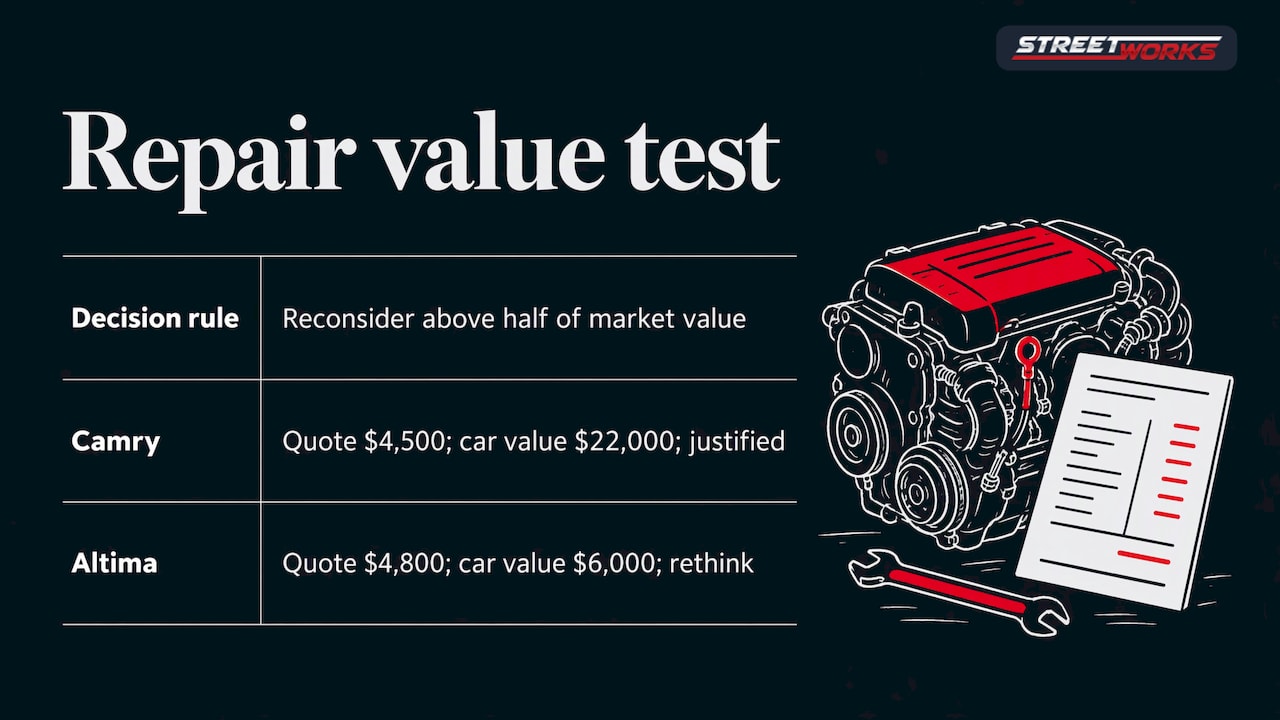
For a standard commuter car, the usual advice is a value test. Empire Auto Protect illustrates a 50% rule: a $4,500 replacement in a $22,000 Camry is easy to justify, while a $4,800 quote on a $6,000 Altima is hard to justify. If the repair costs more than half the vehicle’s market value, it is worth thinking carefully before you proceed.
The value test works differently for the cars our customers bring in, because their value is not just market price.
Classic and muscle cars. The numbers-matching block, the originality of the car and the plan for it all matter. Sometimes the right move is rebuilding the original engine to factory specs. Sometimes it is a modern engine that makes the car reliable in 115-degree summers. Our engine rebuilds page walks through rebuild versus replace for exactly this decision.
Performance builds and restomods. Here the replacement is the upgrade. We handle LS, Coyote and Godzilla engine swaps and conversions, and our Chevy and Ford swap page covers the two most common platforms. Swaps involve more than the engine: mounts, wiring, cooling, fuel system, transmission match and tuning. Pricing for a swap is quoted per project, because those choices set the total.
Porsche. Engine work on these cars is its own specialty, and we handle Porsche repairs and upgrades in the same shop as our performance work.
Cars you plan to keep. The reasoning from the research holds: replacement pays off when the body, transmission and frame are in good shape and you would otherwise take on a new car payment. A good engine in a car you love and know the history of is hard to replace at any price.
A seized engine is not automatically a replacement
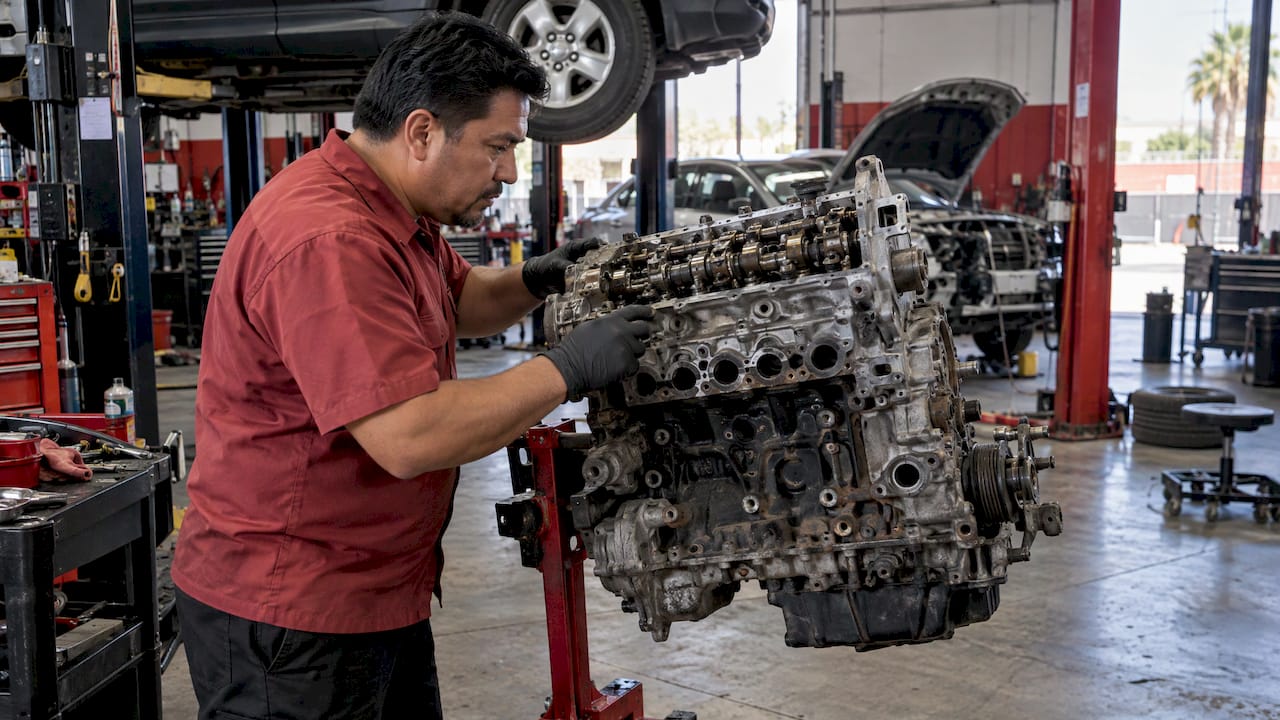
A seized engine, one that will not turn over, does not always mean a new engine. The cause matters: oil starvation, overheating, rust in the cylinders or a broken timing belt each lead to different damage. The only way to know is to inspect it. Sometimes the answer is a rebuild of the original block, sometimes a replacement. Get the diagnosis in writing before you decide.
How to read an engine replacement estimate
The Federal Trade Commission’s Auto Repair Basics says a written estimate should identify the condition to be repaired, the parts needed and the expected labor charge. It should also say the shop will contact you for approval before work goes beyond a set amount of time or money. The same guide advises comparing repair warranties.
A good engine estimate has these lines:
- The engine, described precisely. New, rebuilt, remanufactured or used, with the source and what is included.
- Labor hours and hourly rate. Not a lump sum with no breakdown.
- Related parts. Gaskets, belts, hoses, water pump, radiator, fluids, mounts.
- Diagnostics, shipping and disposal. Any fees that are separate from parts and labor.
- Warranty. How long, what it covers, and whether it pays for labor if the engine has to come out again.
- An approval threshold. The point at which the shop calls you before spending more.
If you are comparing two quotes, line them up against this list. The cheaper one is often the one missing lines.
Check for free coverage first
Before you pay for a replacement, make sure nobody else owes it. If the engine failed from a manufacturer defect while the car is under warranty, the repair may cost you nothing. For recalls, the National Highway Traffic Safety Administration lets you search by your 17-character VIN, and recalled parts are fixed free at a dealership. That check takes a few minutes and can save thousands.
The Phoenix factor
Heat is hard on engines. Cooling systems, hoses, belts, gaskets and fluids all work harder in an Arizona summer, and a replacement that ignores that can fail early. When we plan an engine job, we plan around the vehicle, your goals and Arizona heat and drivability. That means thinking about cooling capacity and the supporting systems, not just the engine that goes in. We serve owners across Phoenix, Scottsdale, Mesa, Tempe, Chandler and Glendale.
Having us replace or rebuild your engine
We do engine rebuilds and replacements, LS and Coyote swaps, custom fabrication, wiring and suspension in one shop, so the engine, the cooling, the wiring and the tuning are planned together instead of passed between vendors. Engine rebuilds are published at $2,500 to $6,000. Replacements and swaps are quoted by project, since the vehicle and the goal set the scope.
To start, tell us the year, make and model, what the engine is doing and what you want from the car. You can reach us through our engine replacement and rebuild page.

If the car is a classic, our classic car restoration team can fold the engine work into a larger plan, so the drivetrain matches the rest of the build.
FAQ
How much does it cost to replace a car engine?
Most replacements cost $2,000 to $10,000 installed, according to SoFi’s guide. Compact cars sit at the low end, while sports cars, luxury vehicles and heavy-duty trucks cost more. A written estimate on your vehicle is the only reliable number.
Is it cheaper to rebuild or replace an engine?
A rebuild of your existing engine is often the lower-cost route for standard engines, with typical rebuilds around $2,500 to $4,000 per SoFi. Specialized or larger engines cost more. For classics and performance cars, the choice also depends on originality and what you want from the car.
How long does an engine replacement take?
Labor is commonly quoted at 10 to 25 hours, according to ConsumerAffairs, though the total calendar time depends on parts availability and the shop’s schedule. Swaps and custom builds take longer, because more systems are involved.
Is it worth replacing the engine in an older car?
It can be, when the body, transmission and frame are sound and the repair is well under the car’s value. A common rule of thumb is to think twice if the cost exceeds half the car’s market value. For classics and cars you plan to keep, sentimental and collector value count too.
Sources
- SoFi: How Much Does an Engine Replacement Cost?
- ConsumerAffairs: How Much Does It Cost to Replace an Engine?
- Empire Auto Protect: Engine replacement cost in 2026
- Michigan Department of State: Consumer’s Guide to Engine Replacement
- FTC: Auto Repair Basics
- PartsMax: How Much Does It Really Cost to Replace an Engine?

