A professional interior detail in the US usually costs between $100 and $350, depending on how deep the cleaning goes, how big the vehicle is and what shape the cabin is in. The U.S. average for an interior-only package in Auto Laundry News’ January 2026 detailing survey was $226.40. That number hides a wide spread. The same words on a menu can mean a 90-minute vacuum and wipe or a four-hour steam-and-extraction job. In Phoenix, where heat and UV punish dashboards, leather and carpet, the right level of detail also protects the car, so it pays to know what you are buying. If you want a Phoenix shop to look at your car and quote it, our detailing team is the place to start.
TL;DR
- Expect $100 to $350 for a professional interior detail on a car, with the national average for interior-only packages at $226.40 in the 2026 Auto Laundry News survey.
- A quick vacuum-and-wipe starts around $100. A complete interior with steam cleaning and hot-water extraction starts around $175.
- SUVs, trucks and vans cost more, and pet hair, odors, smoke and stains are usually priced as add-ons of roughly $40 to $150 each.
- Compare the list of included services, not the package name. Shampoo or extraction is usually what separates a cheap quote from an expensive one.
- Interior-only is cheaper than a full interior and exterior detail, which averaged $349.80 in the same survey.
Table of Contents
- What interior detailing costs in 2026
- What you get at each price level
- What moves the price up or down
- Add-on prices to expect
- A worked example
- Interior only or full detail?
- What the Phoenix climate changes
- How to compare quotes
- Interior detailing at StreetWorks Auto
- FAQ
- Sources
What interior detailing costs in 2026
Published price guides cluster in the same band. Jobber’s April 2026 pricing guide puts the average interior detail at $100 to $300, with most businesses charging $100 to $350 or more depending on size and condition. It also notes that jobs take from about 1.5 hours to more than 4 hours. Zarla’s November 2026 guide lists $100 to $180 for a sedan interior and $150 to $330 for an SUV, truck or van.
The figures that come from a survey of working shops are the most useful. Here is how the January 2026 Auto Laundry News results break down, as national averages for the US:
| Service | Average price |
|---|---|
| Interior-only detail, shop | $226.40 |
| Interior-only detail, mobile | $160.94 |
| Exterior-only detail | $212.11 |
| Complete interior and exterior detail | $349.80 |
Source for all four rows: the Auto Laundry News detailing survey. Averages blend every market and every level of service, so treat them as a midpoint, not a quote. A cabin in good shape with light dust will land below the average. A family SUV with ground-in crumbs will land above it.
What you get at each price level
Price follows labor, and labor follows what the detailer actually does. Autotrader’s detailing cost guide describes two common tiers:
| Tier | Starting price | What it typically includes |
|---|---|---|
| Quick interior detail | $100+ | Vacuuming carpet, mats and upholstery, cleaning interior and exterior glass, leather and vinyl protectant |
| Complete interior detail | $175+ | Everything above, plus steam cleaning of the headliner and surfaces, hot-water extraction of carpet and cloth upholstery, door jamb cleaning |
The same guide prices interior odor elimination as a separate service starting at $75.
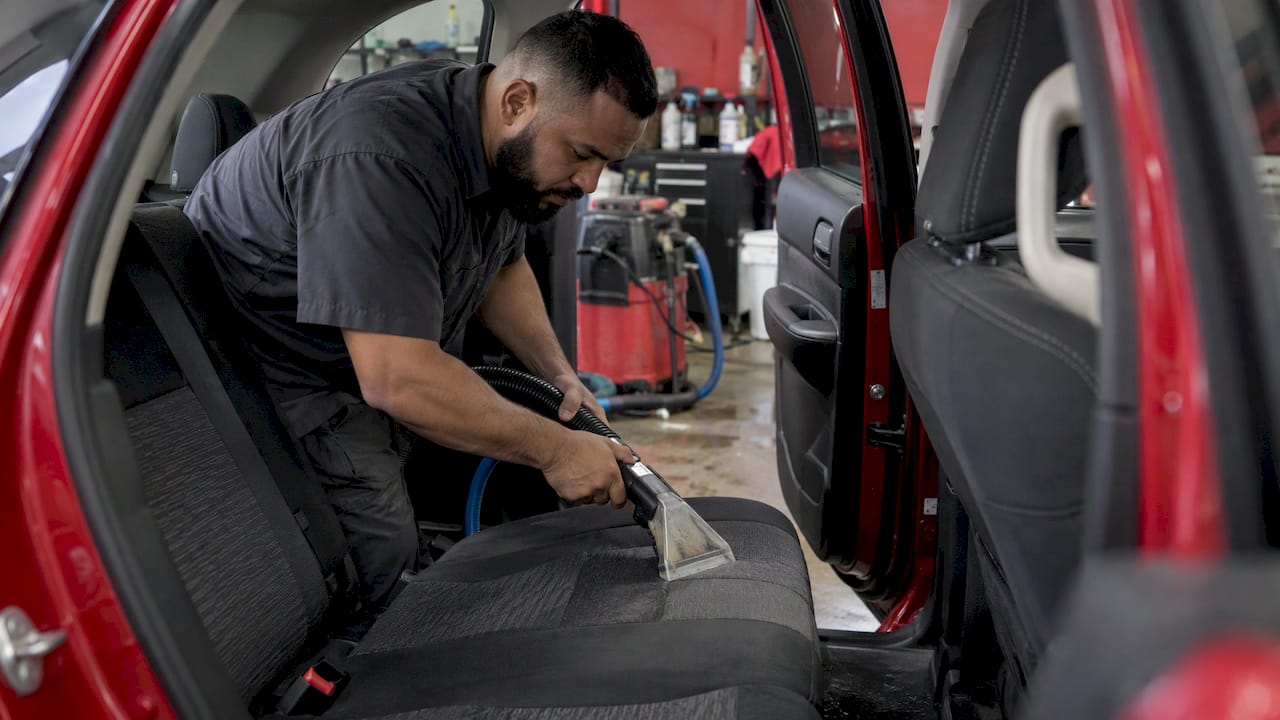
The gap between the tiers is the extraction step. Vacuuming lifts loose dirt. Hot-water extraction pushes cleaning solution into the fibers and pulls the dirty water back out, which is what removes soil, sweat and spills that a vacuum cannot reach. Steam does a similar job on hard surfaces, vents, cup holders and seams. That is why a complete detail costs more and takes longer.
Why “interior detail” is not one product
Two shops can sell an “interior detail” and mean very different jobs. One wipes the surfaces and vacuums the floor. The other pulls the seats’ dirt out of the fabric, cleans the headliner and conditions the leather. When you compare quotes, ask for the list of what is included. If a quote does not mention shampoo, extraction or steam, assume it does not include them.
What moves the price up or down
Four things decide where your quote falls.
Vehicle size
More surface means more time. Zarla’s ranges show it plainly: $100 to $180 for a sedan interior against $150 to $330 for an SUV, truck or van. Third-row seats, crew-cab trucks and minivans with several rows of carpet and upholstery take the most time. Two-seat sports cars and coupes tend to sit at the low end because there is little to clean, though fine leather and tight spaces still take care.
Condition of the cabin
A lightly used cabin takes a standard pass. Pet hair woven into carpet, spilled drinks, sand, smoke residue and mold add hours, and shops typically price them as add-ons rather than folding them into the base price.
Mobile or shop
The survey average for mobile interior-only work, $160.94, sits well below the $226.40 shop average. Mobile service can be convenient, but it limits what equipment and conditions are available. Leather restoration, odor treatment and heavy extraction are easier in a controlled shop, where the car can sit and dry.
Where you live
Prices run higher in expensive metro markets and lower in small towns. Phoenix sits in the middle of the national range, and local prices also reflect how much heat and dust damage the average car has taken.
Add-on prices to expect
Add-ons are where a $150 quote becomes a $300 invoice. Here are the national figures from two sources.
| Add-on | Typical price | Source |
|---|---|---|
| Carpet shampoo | $103.20 average | Auto Laundry News |
| Upholstery cleaning | $103.90 average | Auto Laundry News |
| Leather or vinyl dressing | $41.25 average | Auto Laundry News |
| Deodorizing | $90.57 average | Auto Laundry News |
| Pet hair removal | +$40 to $100 | Zarla |
| Ozone odor treatment | +$50 to $120 | Zarla |
The survey figures are what freestanding shops charge when a service is bought on its own, which is why they look high next to the starting price of a package. Inside a package, the same work is usually discounted. If you know you need shampooing or odor work, ask for a package that includes it rather than stacking separate add-ons.
A worked example
Say you drive a mid-size sedan with a dog. The seats are covered in hair and the carpet has a few coffee stains.
- Base interior detail for a sedan: $100 to $180 (Zarla’s range).
- Pet hair removal: $40 to $100 on top.
- Total: roughly $140 to $280, before any odor treatment.
If the same cabin also smells of smoke, an ozone odor treatment at $50 to $120 puts the total in the $190 to $400 range. The range is wide because condition drives hours, and hours drive price. That is why a reputable shop looks at the car before it commits to a number.
Interior only or full detail?
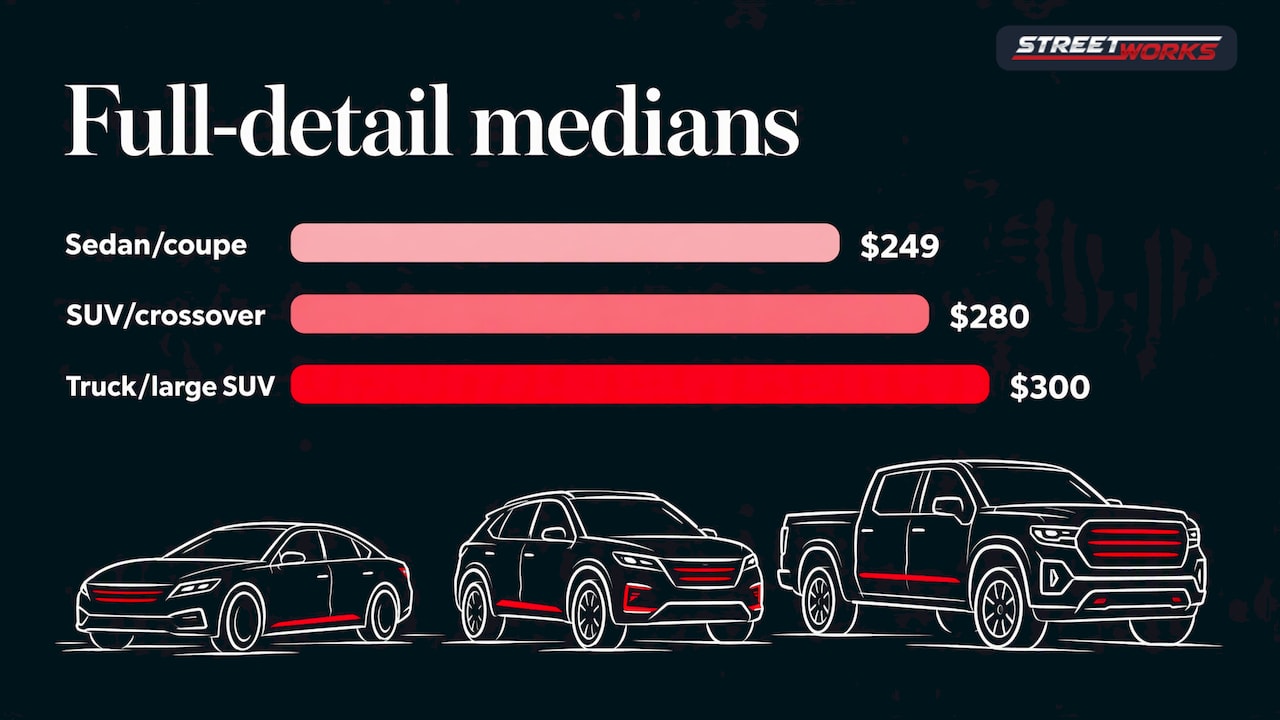
The full interior and exterior detail averaged $349.80 in the 2026 survey, about $123 more than the interior-only average. LaunchKit’s October 2026 guide, which draws on a September 2026 read of advertised prices from more than 2,000 US detailers, reports full-detail medians of $249 for a sedan or coupe, $280 for an SUV or crossover and $300 for a truck or large SUV. It puts interior details at $150 to $250, with a $199 median.
Choose interior-only when the paint is fine and the cabin is what bothers you. Choose the full package when you want the whole car reset, for example before a sale or after a long road trip. If you are paying for both anyway, one booking is usually cheaper than two.
Packages named “basic” are worth reading closely. A multi-state price scan by DrivingGeeks found that many basic packages are little more than glorified washes, and that a truly all-inclusive package is typically the better financial option.
What the Phoenix climate changes
A cabin in the Valley lives through months of triple-digit heat with direct sun through the glass. Dashboards, door panels and leather dry out, vinyl fades, and adhesives soften. A good interior detail in Arizona is therefore about more than cleanliness. Conditioning leather and vinyl, cleaning the surfaces that bake hardest and finishing with a UV-protective dressing keep the materials supple for longer.
This matters for the price too. A car that has sat outside through a summer is dustier and its surfaces are more worn, so it can take longer than the same car in a milder climate. Window tint, which cuts the sunlight reaching the cabin, and paint protection or ceramic coating on the outside work alongside interior care as a complete way to protect a car here.
How to compare quotes
Use this short checklist when you collect two or three quotes:
- Vehicle size. Tell every shop the exact make, model and number of rows.
- Included services. Ask whether the price includes steam, shampoo or extraction, headliner cleaning, door jambs and leather conditioning.
- Condition. Describe pet hair, stains, smoke and odors up front so the quote does not change on the day.
- Time. A thorough interior takes from roughly 1.5 to 4 hours, according to Jobber. A promise of 45 minutes for a full interior means a lighter job.
- Protection step. Ask what is applied to the leather, vinyl and plastics at the end.
The cheapest number is rarely the cheapest result. A $90 wipe-down that leaves stains in the carpet means paying again in a month.
Interior detailing at StreetWorks Auto
We are a Phoenix shop that works on classics, performance cars and Porsches, and we also do auto detailing, paint correction, ceramic coatings, window tinting and paint protection film. For owners of cars that matter to them, that means the cabin, the paint and the protection can be planned together, with Arizona heat and the way you use the car in mind. Our auto detailing page explains what we offer.
If you also want the outside protected, our ceramic coating work has a published single-stage coating price of $700 to $1,200, and our paint correction service restores the finish before a coating goes on. Paint protection film is priced from $900 to $1,500 for a partial front and $1,800 to $2,800 for a full front. Tell us what you drive and what condition the cabin is in, and we will quote the right level of work.
FAQ
How much is interior detailing usually?
Most professional interior details cost $100 to $350 in the US. The 2026 Auto Laundry News survey average for interior-only packages was $226.40, and mobile interior work averaged $160.94. SUVs, trucks and heavily soiled cabins sit at the top of the range.
Is a $100 interior detail enough?
It covers the basics: vacuuming, glass, and a leather and vinyl protectant. It does not typically include hot-water extraction of carpet and seats or steam cleaning of the headliner, which start around $175. If your cabin has stains, odors or years of soiling, plan for the complete tier.
Why do SUVs and trucks cost more to detail?
They have more carpet, more seats and more surface area, and the work takes longer. Zarla’s 2026 ranges show the effect: $100 to $180 for a sedan interior against $150 to $330 for an SUV, truck or van.
Is interior detailing worth it in Arizona?
In a climate with this much sun and heat, regular cleaning and conditioning help keep leather, vinyl and plastics from drying and fading. A thorough interior detail combined with window tint and exterior protection is a practical way to look after a car that lives outdoors here.
Sources
- Auto Laundry News Detailing Survey, January 2026
- Autotrader: How Much Does it Cost to Detail a Car?
- Jobber: Car Detailing Prices 2026
- Zarla: Car Detailing Pricing 2026
- LaunchKit: Car Detailing Prices 2026 Price List Guide
- DrivingGeeks: Car Detailing Prices

